
Onboard new hires in minutes, not days.
A paperless flow the new hire completes before day one. Contract, documents, payroll details and system access, all provisioned by the agent rather than chased by a coordinator.
Capabilities
What happens before day one
Employee record created from the offer
Personal details, role, entity, start date and reporting line land on one record that payroll, attendance and the directory all read from.
Contract issued for e-signature
Generated from your template for the right jurisdiction, sent for signature, and filed against the employee record once signed.
Payroll and WPS profile configured
Salary structure, grade, bank details and, for UAE mainland employers, the WPS identifiers needed for the first run.
Access requested across every system
Email, chat, finance tools and anything else the role needs, raised as requests before the start date rather than as tickets afterwards.
Day-one checklist sent to the manager
With a buddy assigned and a first task that can genuinely be finished in week one and reviewed by someone.
In the product
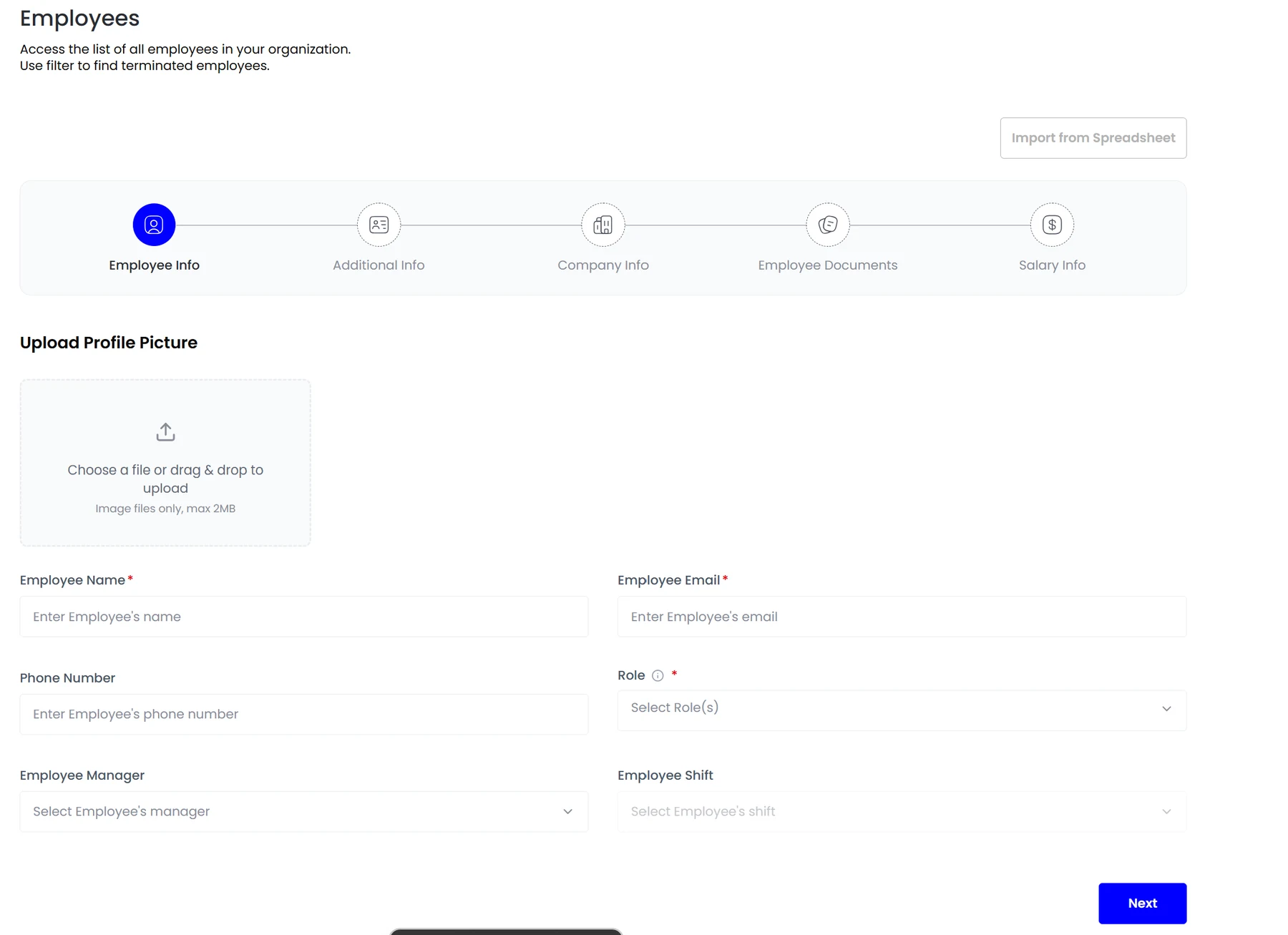
Every new hire moves through the same five steps, with the record created before day one.
Most onboarding checklists are procurement lists. Laptop, email, badge, handbook, done. They are easy to complete and they predict almost nothing, because the reasons people leave in their first quarter are rarely equipment problems.
- Employee record created from the offer
- Contract issued for e-signature
- Payroll and WPS profile configured
- Access requested across every system
How it fits together
What the first ninety days actually decide
Onboarding is usually measured by whether the equipment arrived. The measures that predict whether someone stays are different: whether they had a real task in week one, whether their manager met them on a schedule rather than when it was convenient, and whether they knew who to ask by the end of the first month.
- Pre-boarding
- Day one to week one
- Thirty, sixty and ninety
Onboarding
Their first day should be about the job
Teamio splits the work in two. The administrative half is provisioned automatically from the moment an offer is accepted. The human half, the introductions and the first real task, is scheduled and prompted so a manager cannot quietly skip it.
- Policy acknowledgements captured and stored, not emailed and forgotten.
- Right-to-work and visa steps tracked with an owner and a date.
- Equipment ordered to a confirmed address and tracked to delivery.
- Thirty, sixty and ninety day checkpoints scheduled before the hire arrives.

By the numbers
What it looks like in practice
A manager hiring their first person should be able to follow it without asking HR what happens next. If the process only works when an experienced person drives it, it is not a process, it is that person.
< 1 min
To provision a new hire end to end
5
Systems requested before day one
30/60/90
Checkpoints scheduled automatically
0
Spreadsheets involved
In practice
A hire, from offer to first review
The same sequence runs for every joiner, which is what makes it predictable rather than dependent on who is coordinating it.
Offer accepted
The record is created from the offer details. Role, entity, start date, reporting line and salary structure all land at once, and every downstream step reads them rather than asking again.
Contract out
Generated from your template for the right jurisdiction and sent for signature. When it comes back signed it files itself against the record rather than sitting in someone's inbox.
Payroll configured
Grade, bank details and statutory identifiers are set while there is still time before the first run, which is the difference between a correct first payslip and an apology.
Access requested
Every system the role needs, raised before the start date. Day one is a switch-on rather than a queue of tickets from someone who cannot yet do their job.
Day one to day ninety
The manager receives a checklist with a buddy assigned, and the thirty, sixty and ninety day checkpoints are already in the calendar before the hire arrives.
Compared
Onboarding by hand against onboarding on one record
The tasks are the same either way. What changes is how many of them a person has to remember.
What changes
The test of an onboarding process
Policy acknowledgements captured and stored, not emailed and forgotten.
Right-to-work and visa steps tracked with an owner and a date.
Equipment ordered to a confirmed address and tracked to delivery.
Thirty, sixty and ninety day checkpoints scheduled before the hire arrives.
FAQ
Common questions
What does the new hire actually see?
A single flow they complete before their first day: personal details, documents, bank details and policy acknowledgements. They are not asked for anything twice, and nothing they submit needs re-entering by anyone.
How long does onboarding take with Teamio?
The administrative half completes in under a minute once the offer details are entered. The agent creates the record, issues the contract, configures payroll and raises access requests in sequence, and reports back when each one lands.
Can we keep our own contract templates?
Yes. Contracts are generated from your own templates per jurisdiction, so the wording your legal team approved is the wording that goes out.
What happens if a start date moves?
Change it on the record and the dependent steps follow. The contract, payroll profile and access requests all key off the start date, so a delayed joiner does not need the sequence rebuilding by hand.
Can onboarding differ by country or entity?
Yes. Contract templates, statutory fields and the access a role needs are all set per entity, so a hire in a second country follows that country's flow without a parallel process.
See it running on your own data.
We will show the module working against records that look like yours, not a generic demo.