
The defaults behind every payslip.
Proration basis, unpaid leave treatment and working days decided once, so partial months are handled the same way every time.
Capabilities
The defaults you set
Proration basis
How a partial month is divided when someone joins or leaves mid period, by calendar days or working days.
Standard working days
The denominator used for proration, or the calendar if you would rather it followed the month.
Unpaid leave treatment
Whether payable days are reduced by unpaid leave taken in the period, applied consistently rather than case by case.
Default tax and signatory
A default tax percentage unless a contract overrides it, and the signature stamped on payslip PDFs.
In the product
Defaults applied when payslips are generated, overridable per contract.
The hardest part of a payroll run is rarely a full month. It is the joiner who started on the eleventh, the leaver who finished mid-week, and the person who took three days unpaid.
- Proration basis
- Standard working days
- Unpaid leave treatment
- Default tax and signatory
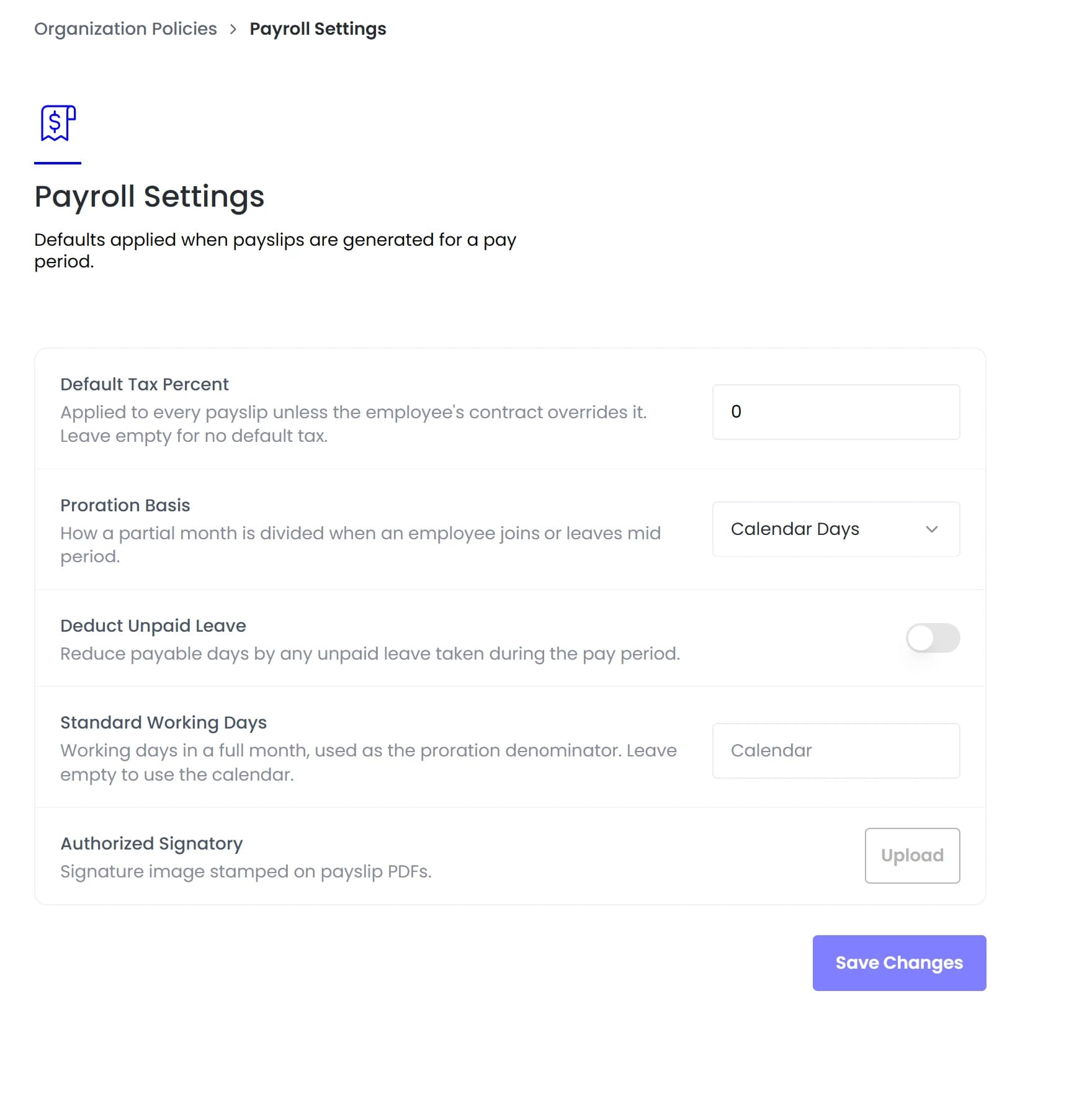
Payroll defaults
Partial months are where payroll breaks
Each of those needs a rule, and the rule needs to be the same every time or two people will calculate the same month differently.

By the numbers
What it looks like in practice
These are defaults, not constraints. An individual contract can override the tax treatment, while everyone else follows the rule without anyone thinking about it.
2
Proration bases to choose from
Set once
Applied to every partial month
Override
Per contract where it differs
Stamped
Signatory on payslip PDFs
In practice
A joiner, a leaver and an unpaid day
Three cases that need a rule, and what each default decides about them.
Someone joins on the eleventh
Proration basis decides whether they are paid for twenty calendar days or the working days remaining, which can differ by a meaningful amount.
Someone leaves mid-week
The same basis applies in reverse, and the final settlement carries any outstanding leave or loan balance alongside it.
Three days unpaid leave
Whether payable days reduce is a setting rather than a judgement, so two people calculating the same month reach the same figure.
A short month
The standard working days figure fixes the divisor, which is what stops February producing a surprise for everyone.
An individual contract
Overrides the default where an agreement genuinely differs, without anyone else being affected.
Compared
The same joiner, two proration bases
Someone starting on the eleventh of a thirty-day month with twenty-two working days.
FAQ
Common questions
Which proration basis should we choose?
Calendar days is easier to explain to employees. Working days better reflects what was actually owed. Either is defensible provided it is applied consistently and matches what your contracts say.
Can an individual contract override these?
Yes. These are defaults. A contract can specify different tax treatment or proration, while everyone else follows the rule without anyone thinking about it.
Does the signatory appear on every payslip?
The uploaded signature is stamped on generated payslip PDFs, so they do not need signing individually.
See it running on your own data.
We will show the module working against records that look like yours, not a generic demo.
Explore more
Payroll Processing
Each pay period becomes a run you can review before anything is paid, with its status visible…
Allowances & Deductions
Define an allowance or deduction once and it applies whenever payslips are generated, to…
Pay Schedules
Define the cycle, the period start and the pay day once, and every run for that group follows…